In plasmas and electrolytes, the Debye length (also called Debye radius), named after Peter Debye, is a measure of a charge carrier's net electrostatic effect in a solution and how far its electrostatic effect persists.[1] A Debye sphere is a volume whose radius is the Debye length. With each Debye length, charges are increasingly electrically screened. Every Debye‐length , the electric potential will decrease in magnitude by 1/e. Debye length is an important parameter in plasma physics, electrolytes, and colloids (DLVO theory). The corresponding Debye screening wave vector for particles of density , charge at a temperature is given by in Gaussian units. Expressions in MKS units will be given below. The analogous quantities at very low temperatures () are known as the Thomas–Fermi length and the Thomas–Fermi wave vector. They are of interest in describing the behaviour of electrons in metals at room temperature.




Physical origin
The Debye length arises naturally in the thermodynamic description of large systems of mobile charges. In a system of 


,
where 


The mobile charges not only contribute in establishing 

,
where 

Identifying the instantaneous concentrations and potential in the Poisson equation with their mean-field counterparts in Boltzmann's distribution yields the Poisson–Boltzmann equation:
.
Solutions to this nonlinear equation are known for some simple systems. Solutions for more general systems may be obtained in the high-temperature (weak coupling) limit, 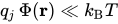
.
This approximation yields the linearized Poisson-Boltzmann equation

which also is known as the Debye–Hückel equation:[2][3][4][5][6] The second term on the right-hand side vanishes for systems that are electrically neutral. The term in parentheses divided by 
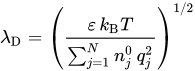
that commonly is referred to as the Debye–Hückel length. As the only characteristic length scale in the Debye–Hückel equation, 

To illustrate Debye screening, the potential produced by an external point charge 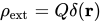
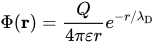
The bare Coulomb potential is exponentially screened by the medium, over a distance of the Debye length.
The Debye–Hückel length may be expressed in terms of the Bjerrum length 
,
where 

In a plasma
In a non-isothermic plasma, the temperatures for electrons and heavy species may differ while the background medium may be treated as the vacuum (
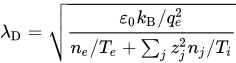
where
- λD is the Debye length,
- ε0 is the permittivity of free space,
- kB is the Boltzmann constant,
- qe is the charge of an electron,
- Te and Ti are the temperatures of the electrons and ions, respectively,
- ne is the density of electrons,
- nj is the density of atomic species j, with positive ionic charge zjqe
Even in quasineutral cold plasma, where ion contribution virtually seems to be larger due to lower ion temperature, the ion term is actually often dropped, giving
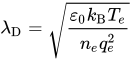
although this is only valid when the mobility of ions is negligible compared to the process's timescale.[7]
Typical values
In space plasmas where the electron density is relatively low, the Debye length may reach macroscopic values, such as in the magnetosphere, solar wind, interstellar medium and intergalactic medium. See the table here below:[8]
In an electrolyte solution
In an electrolyte or a colloidal suspension, the Debye length[9][10][11] for a monovalent electrolyte is usually denoted with symbol κ−1
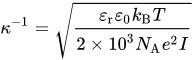
where
- I is the ionic strength of the electrolyte in molar units (M or mol/L),
- ε0 is the permittivity of free space,
- εr is the dielectric constant,
- kB is the Boltzmann constant,
- T is the absolute temperature in kelvins,
- NA is the Avogadro number.
or, for a symmetric monovalent electrolyte,
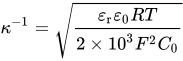
where
- R is the gas constant,
- F is the Faraday constant,
- C0 is the electrolyte concentration in molar units (M or mol/L).
Alternatively,
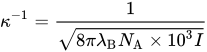
where
For water at room temperature, λB ≈ 0.7 nm.
At room temperature (20 °C or 70 °F), one can consider in water the relation:[12]
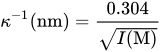
where
- κ−1 is expressed in nanometers (nm)
- I is the ionic strength expressed in molar (M or mol/L)
There is a method of estimating an approximate value of the Debye length in liquids using conductivity, which is described in ISO Standard,[9] and the book.[10]
In semiconductors
The Debye length has become increasingly significant in the modeling of solid state devices as improvements in lithographic technologies have enabled smaller geometries.[13][14][15]
The Debye length of semiconductors is given:
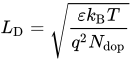
where
- ε is the dielectric constant,
- kB is the Boltzmann's constant,
- T is the absolute temperature in kelvins,
- q is the elementary charge, and
- Ndop is the net density of dopants (either donors or acceptors).
When doping profiles exceed the Debye length, majority carriers no longer behave according to the distribution of the dopants. Instead, a measure of the profile of the doping gradients provides an "effective" profile that better matches the profile of the majority carrier density.
In the context of solids, the Debye length is also called the Thomas–Fermi screening length.
| This article uses material from the Wikipedia article Metasyntactic variable, which is released under the Creative Commons Attribution-ShareAlike 3.0 Unported License. |