Faraday's laws of electrolysis are quantitative relationships based on the electrochemical research published by Michael Faraday in 1833.[1][2] [3]

First law
Michael Faraday reported that the mass(



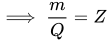
Here, the constant of proportionality 
Second law
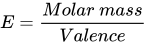
Faraday discovered that when the same amount of electric current is passed through different electrolytes/elements connected in series, the mass of the substance liberated/deposited at the electrodes in g is directly proportional to their chemical equivalent/equivalent weight (


(From 1st Law)



Derivation
A monovalent ion requires 1 electron for discharge, a divalent ion requires 2 electrons for discharge and so on. Thus, if 

So the mass discharged


Where (
Mathematical form
Faraday's laws can be summarized by
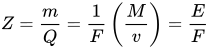
where
For Faraday's first law,
For Faraday's second law, 
In the simple case of constant-current electrolysis, 

and then to

where:
- n is the amount of substance ("number of moles") liberated: n = m/M
- t is the total time the constant current was applied.
For the case of an alloy whose constituents have different valencies, we have
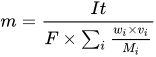
where wi represents the mass fraction of the ith element.
In the more complicated case of a variable electric current, the total charge Q is the electric current I(
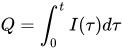
Here t is the total electrolysis time.
| This article uses material from the Wikipedia article Metasyntactic variable, which is released under the Creative Commons Attribution-ShareAlike 3.0 Unported License. |